For a restaurant, a placemat is a rare thing: a piece of advertising the guest is more or less obliged to look at for the length of a meal. That makes the specification worth getting right, because the same design reads very differently on a cramped mat than on a generous one, and the same order costs very differently depending on how it is printed. Four decisions carry most of the outcome: the size, the paper, the print process, and the quantity. Work through them in that order and the placemat does its job without surprises on the invoice.
Start with the size
Placemat sizes are more standardized than they look, and each common format has a setting it suits. The 10 by 14 inch mat is the classic diner and cocktail size, compact enough for tight two-tops and a natural fit for kids’ activity mats. The 12 by 18 inch format is the standard dining workhorse, giving a full place setting room without crowding the table, while larger 14 by 20 inch mats suit generous settings and fine-dining covers. Square 14 by 14 mats and long 12 by 24 inch buffet runners cover the less common cases. The chart below draws the popular formats to scale so the real difference in footprint is obvious; a jump from 10 by 14 to 12 by 18 is a substantial gain in usable space, not a rounding difference.
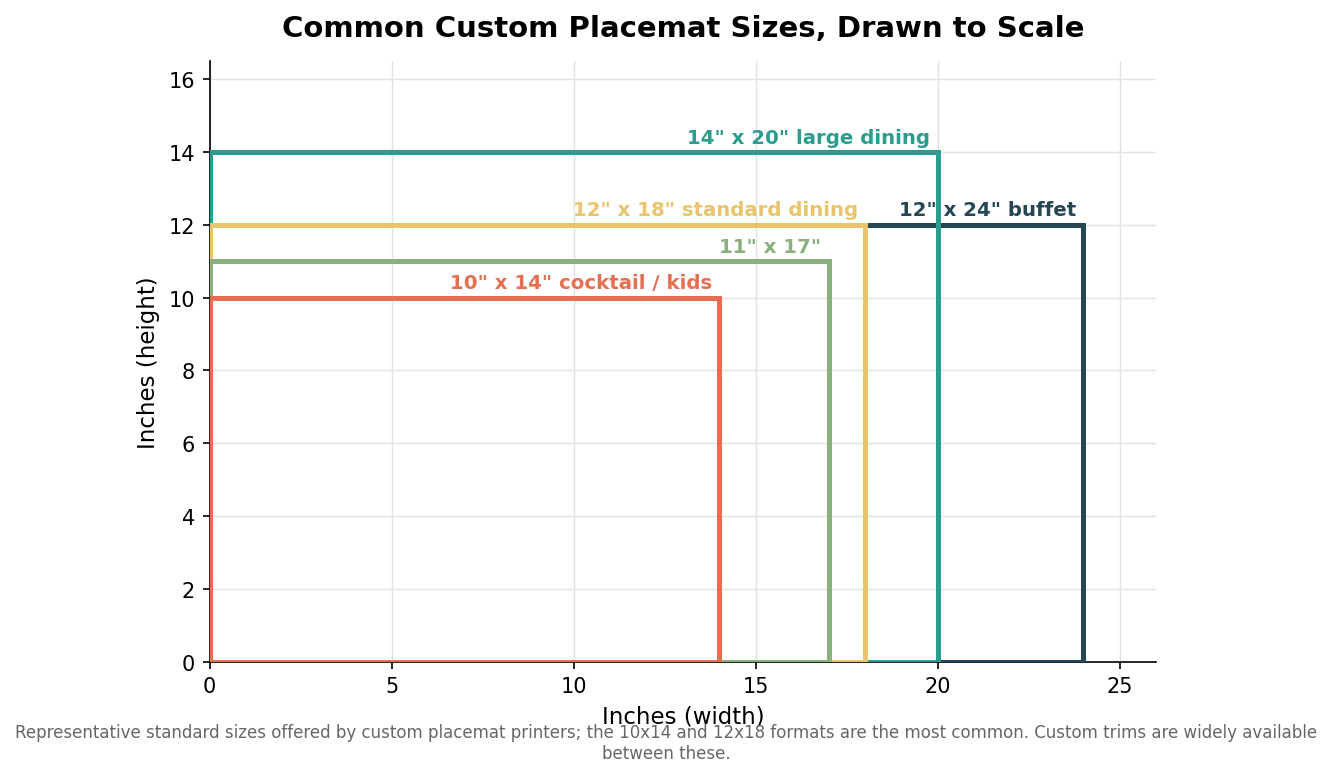
The size you pick should follow your actual table dimensions and place settings, not habit. Measure the table, lay out a full setting, and confirm the mat frames the plate and flatware with a margin rather than running off the edge, since an oversized mat that overhangs looks worse than a correctly sized smaller one.
Paper stock and weight
The paper is where function meets budget. Custom placemats are commonly printed on uncoated stock in the range of roughly 40 to 70 pounds, and the weight you choose is a real tradeoff. Lighter food-grade greaseproof papers, often in the 40 to 45 pound range and a few thousandths of an inch thick, are made to resist grease bleed-through and suit casual, high-turnover service where the mat is genuinely disposable. Heavier uncoated stocks, up to around 70 pounds, feel substantially more substantial in the hand, closer to a card than a napkin, and read as more upscale, at a higher per-piece cost. Color capacity tracks weight and coating too, with heavier and better sheets holding more ink and finer detail. If food will sit directly on the mat, food-grade greaseproof stock is the responsible default; if the mat is primarily a presentation and advertising surface, a heavier uncoated sheet earns its keep.
The print process and how it scales with quantity
How your placemats are printed is dictated largely by how many you need. Digital printing is economical for short runs, which is why custom placemats can start as low as roughly 25 to 100 pieces, making it feasible to print a weekend special or an event mat. Offset lithography becomes the cost-effective choice as volumes climb into the thousands, delivering fine detail; presses commonly run around a 200-line screen and support up to eight colors, with the option to print right to the edge or leave a small border. For very large recurring runs, flexography and gravure take over. The chart below shows the rough volume band where each process typically makes sense.
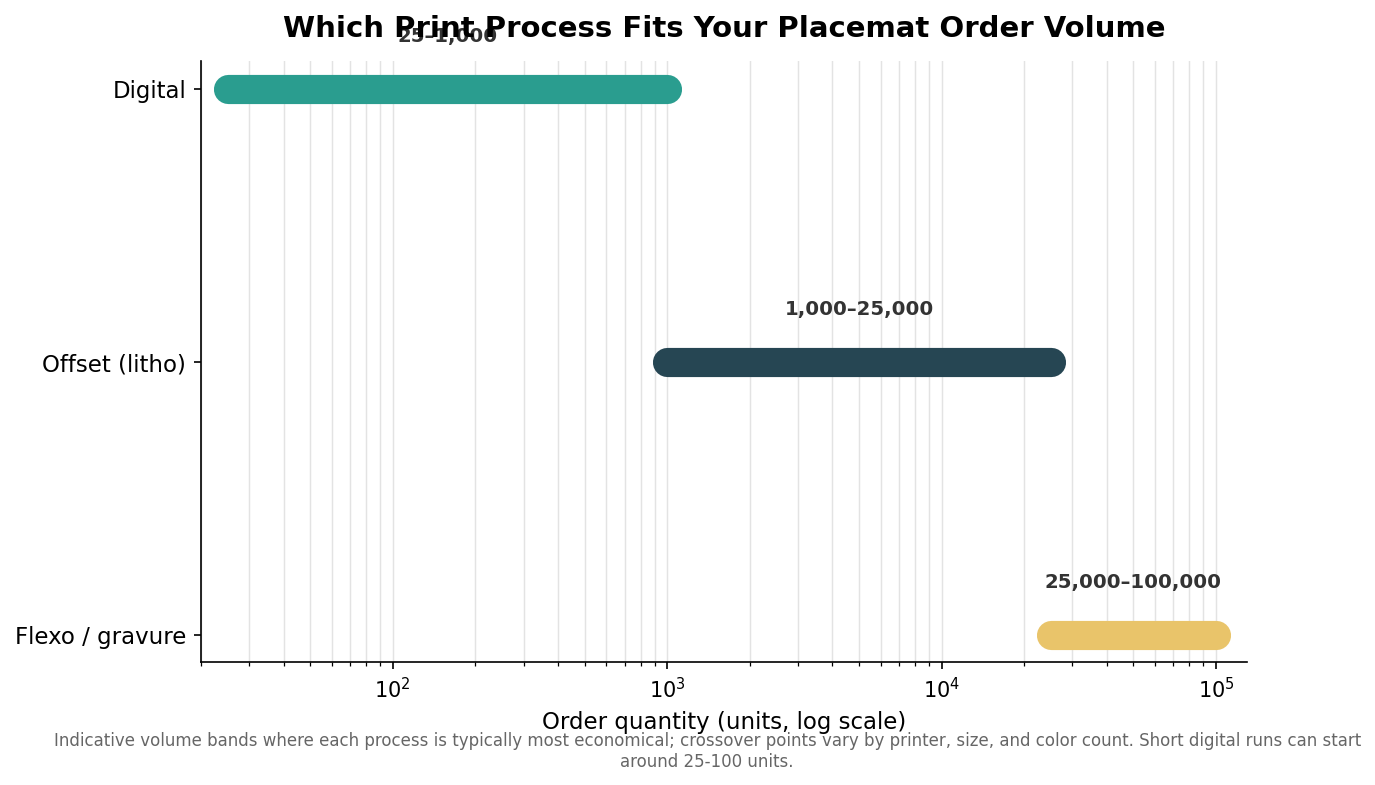
The practical implication is to size your run to the process rather than fighting it. Ordering 300 mats on a process meant for 30,000 is expensive per piece, and stretching a short-run digital job to tens of thousands leaves savings on the table. If you reprint the same design regularly, quoting a larger offset run and storing the surplus is often cheaper per meal than repeated small orders.
Quantities, packaging, and lead times
Minimums are low and turnaround is fast at the short-run end. Many printers set a floor around 25 to 100 pieces for digital custom work and offer a long ladder of quantity tiers up into the tens of thousands, with the per-unit price falling sharply as you climb it. Short digital runs frequently turn around in about two to three business days, while larger conventional runs are more often quoted in the range of roughly six to eight business days plus shipping, with expedited options available at a premium. Placemats are typically boxed in flat cartons straight off the press with no additional trimming, which keeps handling costs down. As with any dated or event-specific order, plan backward from the day you need them on the tables and leave a buffer for proofing and delivery.
Designing a placemat that earns its space
A placemat is a layout problem, not just a print job. The center of the mat will be covered by a plate for most of the meal, so the durable real estate is the border, which is where a logo, a QR code to the menu or reviews, a loyalty offer, or a short story about the restaurant belongs. Designs that reach the edge need bleed, meaning image carried slightly beyond the trim line so a small shift on press does not leave a white sliver, and anything you cannot afford to lose should sit a safe margin inside the edge. Keep type large enough to read at arm’s length across a table, use color and contrast that survive on uncoated stock rather than assuming screen-bright results, and remember that on lighter greaseproof papers a little ink spread is normal. Handle the size, stock, process, and quantity deliberately, then design for where the plate is not, and a paper placemat becomes one of the cheapest advertising impressions a restaurant can buy.